
Chọgharịa narị narị nka edoziri maka Claude, Cursor, na ndị ọzọ.
The Best AI Skills for Indie Game Character Design in 2026: From Sketch to Sprite Sheet in One Day
The best AI skills for indie game character design in 2026 turn a one-line description into a full hero kit - idle loop, walk cycle, attack frames, death animation, and emotes - in a single afternoon. Character art has been the #1 line item on indie budgets for a decade. A commissioned 2D hero typically runs $500 to $5,000 per character for a full sprite sheet, and a stylized 3D character with rigging clears $2,000 to $8,000 before animation. Solo devs and jam teams have been priced out of the genres they want to ship.
That math just changed. With Vibe Skills, the character pipeline - design, consistency, frame breakdown, and export to sprite sheets or Unity-ready meshes - is pre-built. You describe the character, the skill ships the kit.
This guide covers the 5 AI character design skills we recommend on Vibe Skills, the anatomy of a real game-ready character, and the one-day workflow indie devs use to go from blank page to a hero you can drop into Aseprite, Phaser, Unity, or a Three.js scene.
Chọgharịa narị narị nka edoziri maka Claude, Cursor, na ndị ọzọ.
Why Character Art Is Indie Dev's Top Cost
Character art is the single largest budget line for indie games, and it has been since 2D platformers gave way to animated heroes in the 90s. The cost stack is brutal once you actually price it out:
- Concept art: $200 to $1,200 for a single hero turnaround (front, side, back).
- Pixel art sprite set: $500 to $3,000 for idle + walk + attack + death at 32x32 or 64x64.
- High-res 2D character with rig: $1,500 to $5,000 for Spine or DragonBones.
- Stylized 3D character (low-poly): $2,000 to $8,000 with rigging, no animation.
- Animation per cycle: $150 to $600 per state, and a basic action game needs 6 to 12 states.
A four-character roster with full sprite sheets can cost a solo dev $10,000 to $30,000 before a single line of game logic ships. That is why so many jam games look identical: free asset packs are the only option, and there are only so many of them.
The other half of the problem is consistency. Even if you can afford the artist, getting four characters that feel like they belong in the same game requires either one artist for everything (slow) or a strict style guide (which most freelancers will quietly ignore). Most jam teams burn out on character art before they ever build a real level.
AI character skills break both walls at once. A pre-built skill knows what a sprite sheet needs to contain, what a walk cycle looks like, and how to keep a character on-model across every frame. The output drops straight into Aseprite, Phaser, Unity, Godot, or a Three.js scene.
Chọgharịa narị narị nka edoziri maka Claude, Cursor, na ndị ọzọ.
Character Art Anatomy: What a Game-Ready Hero Actually Needs
A game-ready character is not one drawing - it is a kit of states, frames, and emotes that the engine can swap based on player input. Skipping any state breaks the feel of the game. Here is the minimum set most action and platformer titles ship with:
| State | Frame count | Loop type | What it conveys | Engine usage |
|---|---|---|---|---|
| Idle | 4 to 8 frames | Looping | Character is alive, breathing | Default state when no input |
| Walk | 6 to 8 frames | Looping | Movement at base speed | Triggered by directional input |
| Run | 6 to 8 frames | Looping | Sprint or dash | Triggered by sprint button |
| Jump | 3 to 5 frames | One-shot | Lift off + apex + landing | Triggered by jump button |
| Attack | 4 to 8 frames | One-shot | Combat action | Triggered by attack button |
| Hurt | 2 to 4 frames | One-shot | Took damage | Triggered by collision |
| Death | 6 to 12 frames | One-shot | Final state | Triggered at 0 HP |
| Emote (wave, taunt) | 4 to 8 frames | One-shot | Personality + multiplayer comms | Triggered by emote menu |
A solid action hero ships with 8 to 12 states minimum. A platformer can get away with 6. A puzzle game with a static avatar can do 2 (idle + happy). Before generating anything, pick the genre, then pick the state list. The skill takes the list as input.
The other thing a game-ready character needs is consistent silhouette and palette across every frame. If the head size shifts between idle and walk, or the cape color jumps three shades on attack, the character reads as broken. Consistency is exactly what AI character skills are built to enforce - every frame is generated against a locked reference image.
How AI Character Skills Actually Build a Hero
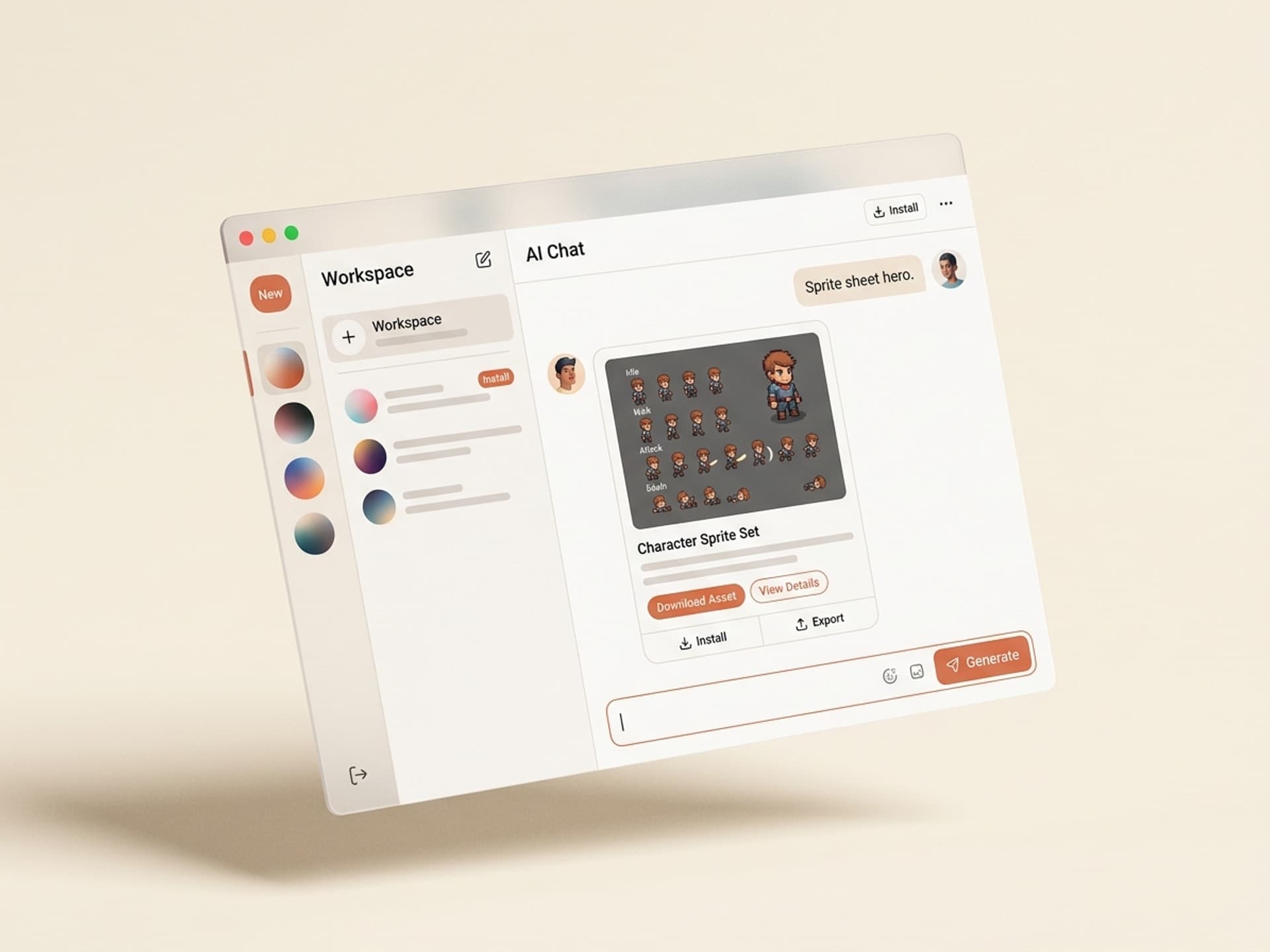
An AI character design skill on Vibe Skills runs in four phases: you describe the character (one line is enough), the skill locks a reference image, generates each animation state against that reference, and exports a packed sprite sheet plus an asset config the engine can read.
Here is what the skill handles for you so you don't touch a Photoshop layer:
- Reference lock. The first generation is the hero turnaround (front, side, back). Every subsequent frame is generated against this lock so the silhouette and palette never drift.
- State breakdown. You pick the state list (idle, walk, attack, etc.) from a checklist. The skill generates the right number of frames per state.
- Frame-perfect timing. Walk cycles loop on contact. Attack frames have anticipation, action, and recovery. Death animations have the long pause at the end. The skill knows the timing rules.
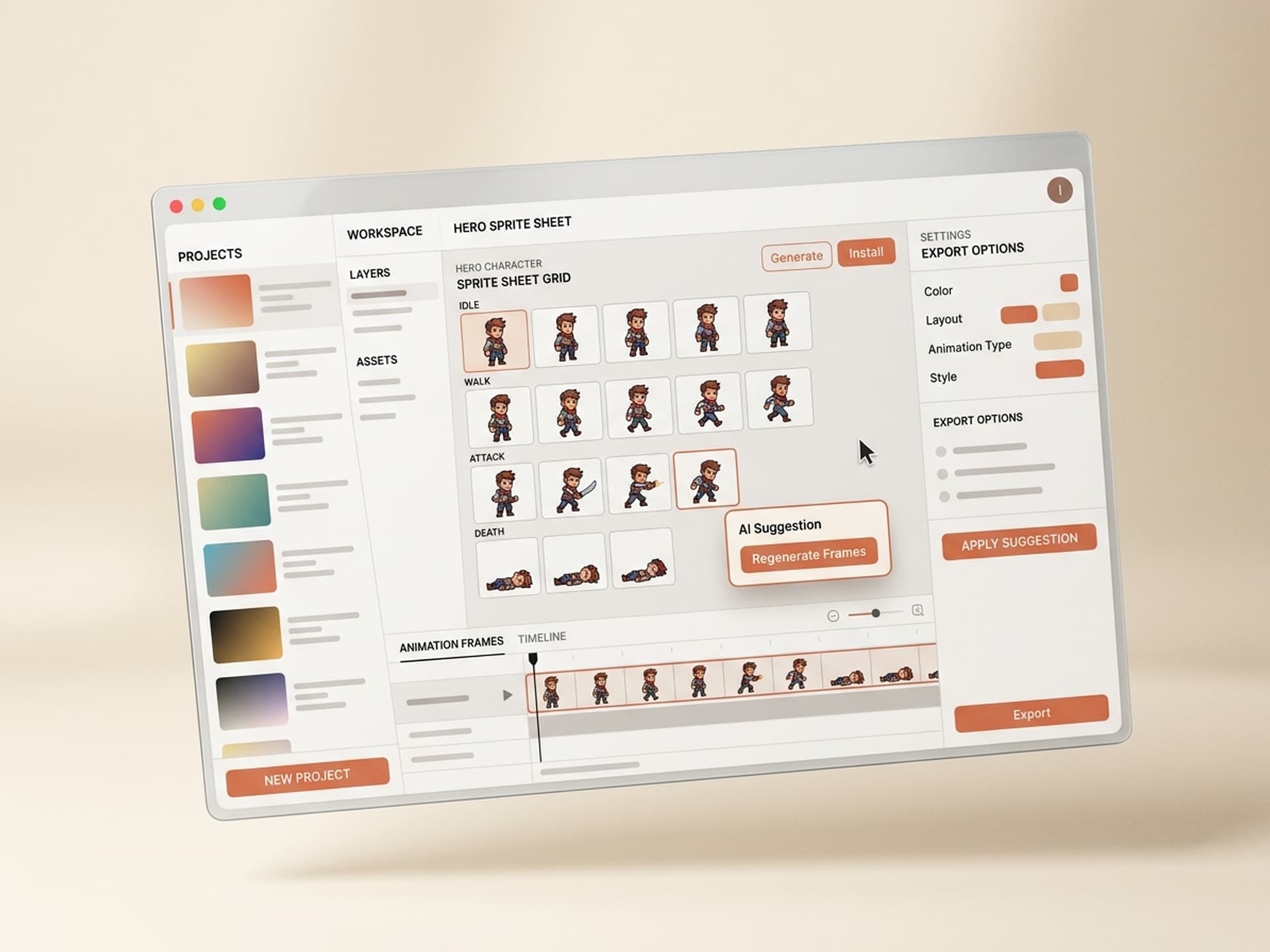
- Sprite sheet packing. Output is a single PNG with a JSON atlas (Phaser, Unity, Godot, Aseprite formats supported). Drop in, point engine at it, character moves.
- Palette + style guide. The skill outputs a hex palette and a one-page style guide, so any future characters in the roster stay visually consistent.
- Engine-ready exports. Pixel art skills export at clean integer scales (1x, 2x, 4x). 3D skills export as glTF with a basic rig (Mixamo-compatible) for Unity, Unreal, or Three.js.
The skill is the art director + the animator + the asset packer + the engine integration in one. Without one, a solo dev will still be tweaking individual walk frames in Aseprite at 2am while the rest of the game waits.
Browse character design skills on Vibe Skills →
The 5 AI Character Design Skills on Vibe Skills
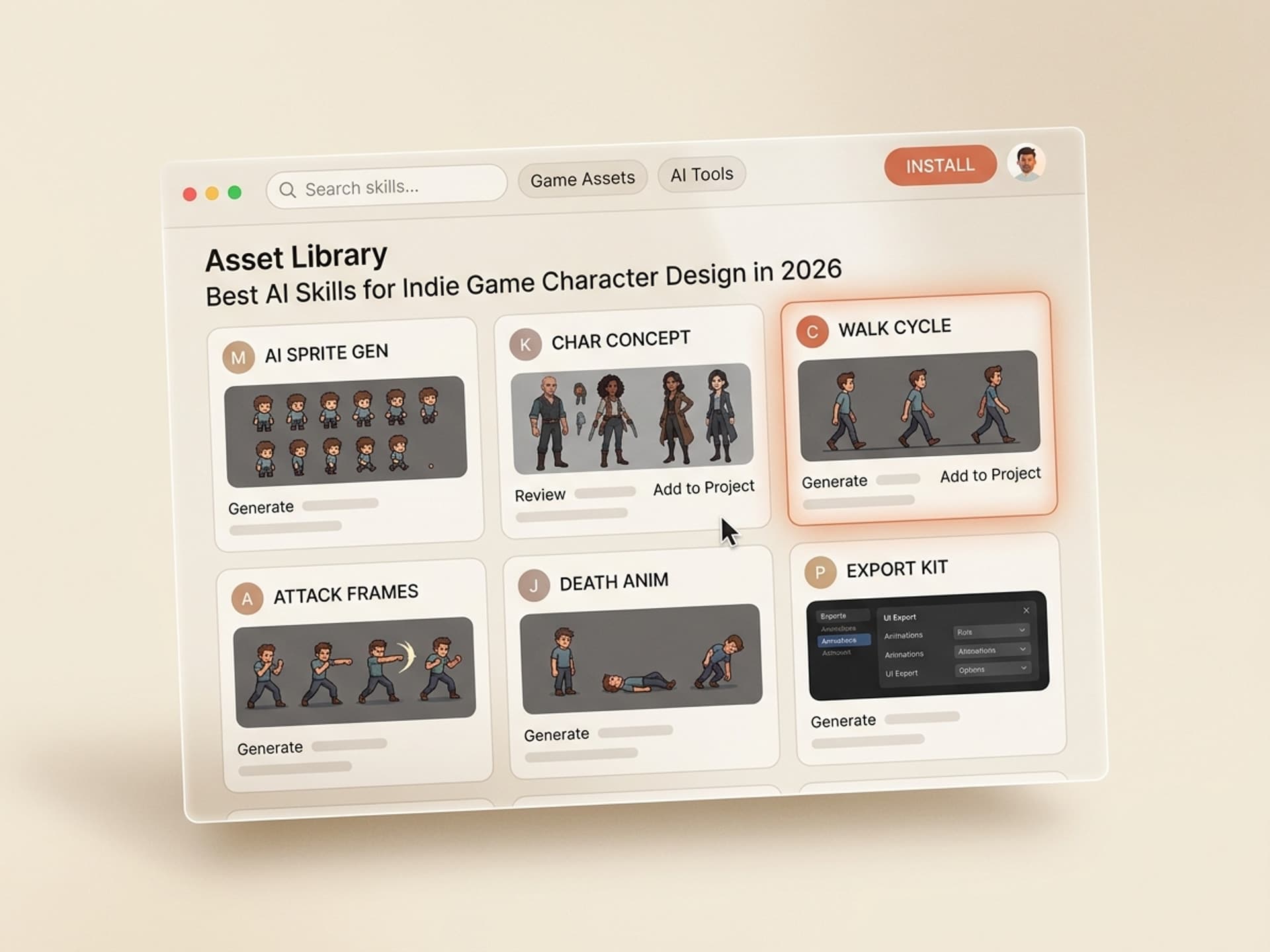
The 3D Games category on Vibe Skills covers character pipelines for every common indie game shape - pixel platformers, top-down RPGs, side-scrollers, web 3D, and casual mobile titles. Here are the five we recommend most for indie devs and jam teams in 2026.
1. Pixel Hero Sprite Skill
Best for: Solo devs and jam teams shipping a 2D platformer, top-down RPG, or roguelike.
The skill generates a full pixel-art hero kit at your chosen resolution (16x16, 32x32, 48x48, or 64x64). Output includes idle, walk, run, jump, attack (3 variations), hurt, death, and 2 emotes. Sprite sheet exports for Aseprite, Phaser, Godot, and Unity are packed automatically. Average ship time: 2 hours from brief to engine-loaded character.
2. Side-Scroller Boss Skill
Best for: Indie devs who need scaled-up enemies and bosses that match their hero style.
Bosses are 2x to 6x the size of the hero with multi-phase attack patterns. The skill generates 3 attack states, a vulnerable / stunned state, a phase-transition animation, and a defeat sequence. Output is consistent with whatever hero style you have already locked, so the boss feels like part of the same game.
3. Top-Down RPG Character Roster Skill
Best for: RPG and adventure devs who need an NPC roster (5 to 20 characters) that feels coherent.
Generate a full town worth of NPCs from a single style brief: shopkeeper, blacksmith, child, elder, guard, merchant. Every NPC shares palette, proportion, and silhouette rules. Each ships with idle + walk + 1 talk emote. Cuts roster art from 3 weeks of freelance work to a single afternoon.
4. Low-Poly 3D Character Skill
Best for: Three.js, Unity, or Godot devs building stylized 3D web games or casual mobile titles.
The skill generates a low-poly stylized character (under 5,000 polys) with a basic Mixamo-compatible rig. Output is glTF + textures. Drop into a Three.js scene, Unity URP, or Godot 4 - rig is ready for Mixamo animations or your own. Perfect for browser-game jams where heavy character meshes break the load budget.
5. AI Influencer Character Crossover Skill
Best for: Devs who want to pull a content character (TikTok mascot, Twitch avatar) into a game world.
This is the bridge between the AI Influencers category and the 3D Games category. Take a content-first character and re-export it as a game-ready sprite sheet or 3D mesh. Useful for creators who already have a built audience around a character and want to ship a tie-in browser game.
Over 30 character and asset skills in the category. All included in a Vibe Skills subscription.
Browse all character skills on Vibe Skills →
Ship a Hero Character in 1 Day: The Workflow
This is the workflow indie devs and jam teams use to go from blank concept to a fully animated, engine-ready hero in a single working day. Total time: 6 to 8 hours, including coffee breaks.
Step 1: Pick the Skill on Vibe Skills (10 min)
Go to the 3D Games category on Vibe Skills and pick the skill that matches your engine and art style. Pixel platformer? Pixel Hero Sprite Skill. Three.js web game? Low-Poly 3D Character Skill. Top-down RPG with a town? RPG Roster Skill. Install takes 30 seconds.
Step 2: Write the Hero Brief (20 min)
One paragraph is enough. Cover: who the character is (rogue, mage, mech pilot), key visual traits (red hood, glowing eye, mech leg), color palette (3 to 5 hex codes), and genre context (16-bit pixel, low-poly stylized, anime side-scroller). Skip the lore - the skill only needs visuals.
Step 3: Generate the Reference Lock (15 min)
The skill generates a hero turnaround: front, three-quarter, side, back. Pick the version you like best. This becomes the locked reference for every animation state. Spend 15 minutes regenerating until the silhouette and palette feel right - it is much cheaper to iterate here than after 80 frames are generated.
Step 4: Pick the State List (10 min)
Tick the boxes for the states you need: idle, walk, attack, etc. For a platformer, 6 states is enough. For an action game, 10 to 12. Don't over-spec on day one - you can always come back and generate more.
Step 5: Generate All Animation States (2 to 3 hours)
The skill runs through every state and generates the frames. This is mostly hands-off - check in every 30 minutes to approve frames. Most states pass on the first try because the reference lock keeps everything on-model.
Step 6: Pack the Sprite Sheet + Engine Drop (30 min)
The skill exports a sprite sheet PNG + JSON atlas. Drop into Aseprite to preview animations, then into your engine (Phaser, Unity, Godot, or Three.js). Wire up the state machine: idle on no input, walk on movement, attack on button press, etc.
Step 7: Polish + Export Backup (1 hour)
Tune any frames in Aseprite if you want to add personality (a slight head bob, a longer cape flow). Export an Aseprite source file as a backup. You're done - hero is in the game by dinnertime.
Total: under 8 hours from "I want a hero character" to "hero is running around in my game". The previous floor was 2 to 6 weeks.
Frequently Asked Questions
Pixel art vs vector vs 3D - which character style ships fastest?
Pixel art ships fastest - smaller frames, tighter constraints, fewer details to keep consistent. A pixel hero kit is doable in under 4 hours. Vector and stylized 3D add 2 to 6 hours for rigging and engine integration. For a weekend jam, pick pixel. For a polished launch, low-poly 3D is worth the extra time. Both are covered in the 3D Games category on Vibe Skills.
Do I need a sprite sheet, or can I use individual frame files?
You need a sprite sheet for any production game. Individual frames work in prototypes but kill performance once you have more than 3 characters on screen. Every Vibe Skills character skill exports a packed sprite sheet with a JSON atlas in formats Phaser, Unity, Godot, and Aseprite all read natively.
How does the skill keep a character consistent across 80 frames?
The skill locks the first generation as a reference image, then conditions every subsequent frame against that lock. Silhouette, palette, head size, and key visual details (cape, weapon, hood) stay identical across idle, walk, attack, and death. This is the single biggest reason raw image generators fail at character art - they have no concept of frame-to-frame consistency. The Vibe Skills character skills are built around this constraint. Browse the 3D Games category to preview real outputs.
Can I edit individual frames after the skill generates them?
Yes - all outputs export as Aseprite source files (for pixel art) or glTF + texture files (for 3D). Edit any frame in your usual tool, repack the sprite sheet, drop it back in your engine. Most devs touch up 2 to 5 frames per character for personality - the rest typically ships as-is.
What engines do these skills export to?
The 2D character skills export sprite sheets readable by Phaser, Unity, Godot, Aseprite, PixiJS, Construct, and GameMaker. The 3D character skills export glTF for Three.js, Unity, Unreal, Godot 4, and Babylon.js. The Mixamo-compatible rig means you can pull any free Mixamo animation onto your character for free.
How much would it cost to get this same kit from a freelancer?
A pixel-art hero kit with idle, walk, attack, hurt, and death cycles runs $1,500 to $4,000 from a mid-tier freelancer. A low-poly 3D character with rig runs $2,500 to $8,000. A full town NPC roster (10 characters) clears $10,000 to $25,000. A Vibe Skills subscription is $39 a month and includes unlimited character generations across every skill - it pays back on the first hero. See pricing.
Will my game look generic if I use AI character skills?
No, because the style brief is yours. The skill enforces consistency and ships the boilerplate, but the character description, palette, and visual hooks come from you. The same skill can generate a brutalist sci-fi mech and a cottage-core forest spirit depending on what you put in the brief. The reason most AI-generated characters look generic is that the brief was generic. Spend 20 minutes on it.
Final CTA: Stop Pricing Yourself Out of Your Own Game
The single biggest reason indie devs ship empty levels with placeholder art is character cost. AI character skills on Vibe Skills cut the cost from $1,500 to $30,000 per project down to a $39 subscription and a working day of your time. Hero, boss, NPC roster, all consistent, all engine-ready, all yours.
If you have ever shelved a game idea because you couldn't afford the art, that excuse is gone in 2026. Pick a skill, write the brief, ship the hero today.
Browse character design skills on Vibe Skills →
Stop priced out of your own game. Install a character design skill on Vibe Skills and ship the hero by dinner.