
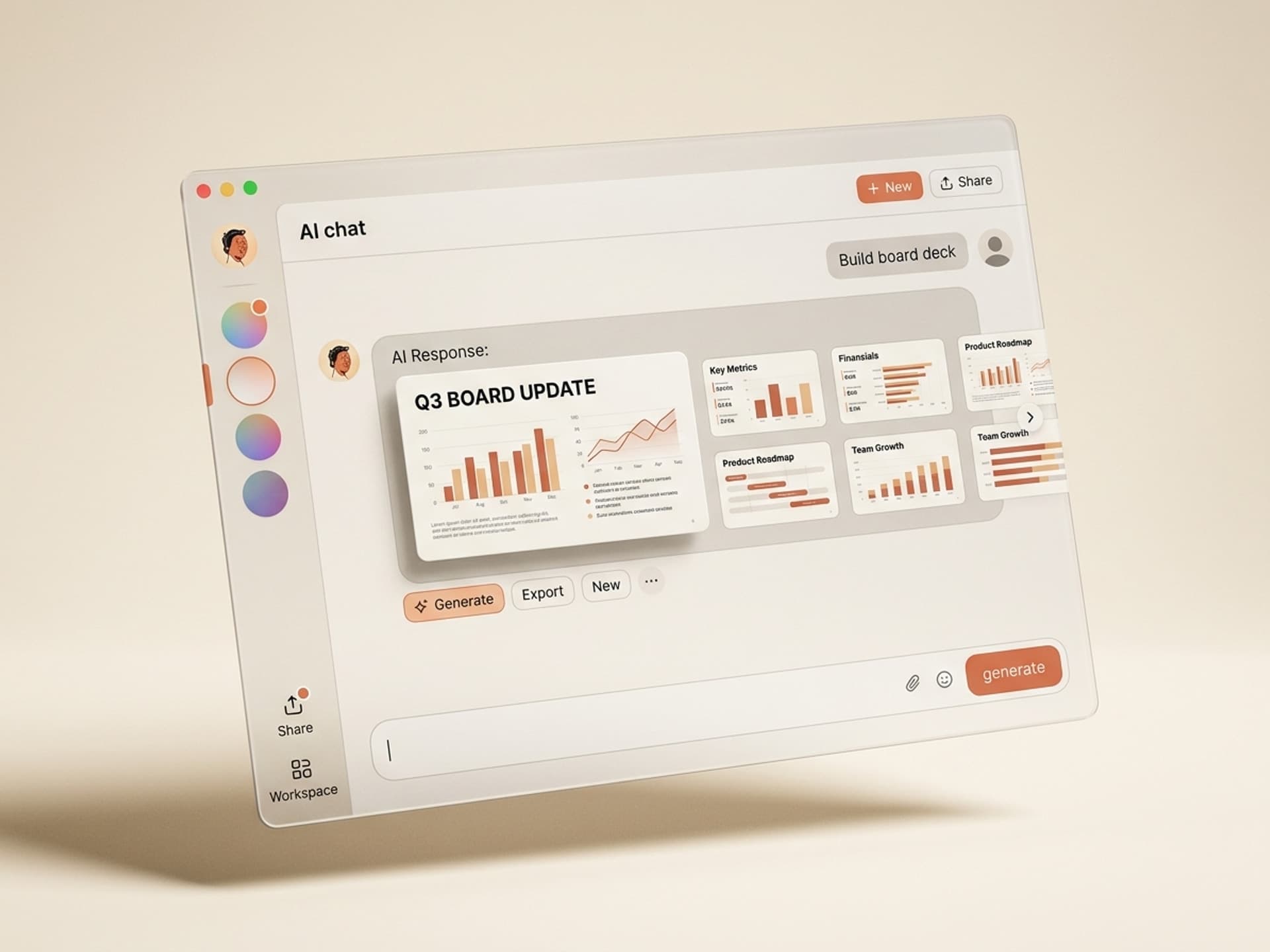

Claude, Cursor, ਅਤੇ ਹੋਰਾਂ ਲਈ ਸੈਂਕੜੇ ਤਿਆਰ-ਕੀਤੇ ਹੁਨਰ ਬ੍ਰਾਊਜ਼ ਕਰੋ।
The Best AI Skills for Board Update Decks: What Changed in 2026
The best AI skills for board decks compress quarterly prep from 14 hours to under 60 minutes, and they ship on the same investor-grade format that YC alumni and Series B founders use to keep their boards aligned. The bar moved in 2026: a recycled deck no longer protects your authority, and a generic ChatGPT board deck definitely does not.
Founders running a Series Seed to Series B board spend an average of 8 to 15 hours per quarter on the deck itself, before a single board prep call. AI skills collapse the formatting and narrative work, leave the founder in charge of the strategic message, and ship a brand-consistent file in Figma, PowerPoint, or Google Slides.
This guide covers why board decks are a quarterly time tax, what a modern board update has to cover, the board deck AI skills on Vibe Skills we recommend, and the 1-hour workflow to ship a board update that actually drives the meeting.
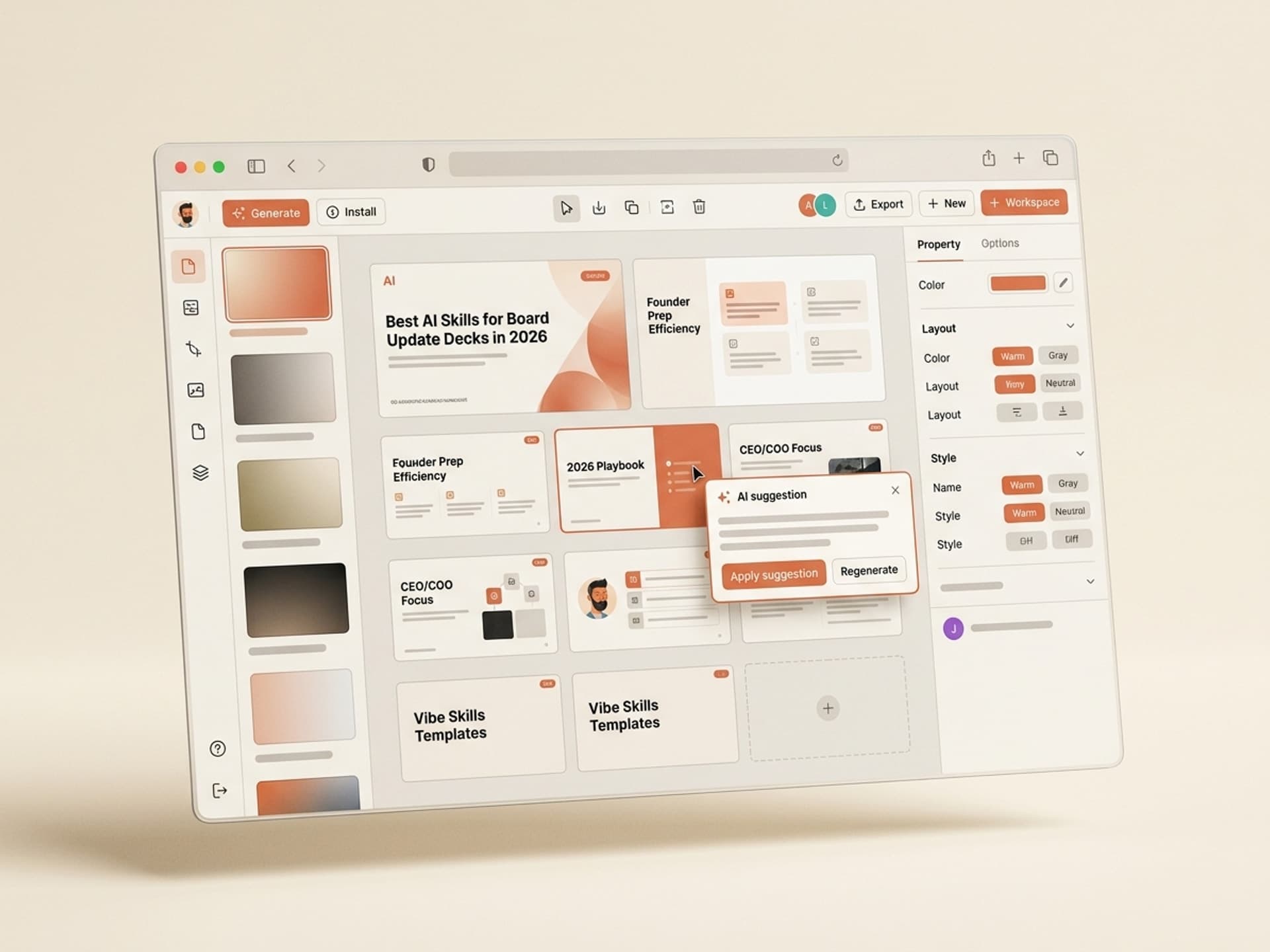
Claude, Cursor, ਅਤੇ ਹੋਰਾਂ ਲਈ ਸੈਂਕੜੇ ਤਿਆਰ-ਕੀਤੇ ਹੁਨਰ ਬ੍ਰਾਊਜ਼ ਕਰੋ।
Why Board Decks Are a Founder Time Tax
A board deck is not a status report. It is the founder's quarterly proof of judgment. Every page tells the board whether you understand the business well enough to keep running it. That's why founders over-prepare, over-edit, then ship something stiff at midnight the night before the meeting.
The math is brutal:
- 4 board meetings a year is standard from Series Seed onward
- 8 to 15 hours of deck prep per meeting is the founder average across the Bridget Harris board deck framework that most YC and Techstars founders adopt
- 32 to 60 hours per year spent on a deliverable read once and then archived
That's a full work week per year, paid for at founder time, on a single recurring artifact. Designers don't ship board decks. Agencies are too slow. Templates miss the brand. So the founder owns it forever.
An AI skill changes that calculation. Board deck skills on Vibe Skills are purpose-built for the format and produce a v1 in 5 to 8 minutes. The founder still owns the strategic message. The skill owns the layout, the typography, the chart styling, and the narrative scaffolding. The deck stops being a time tax and becomes a 1-hour exercise in editing the 20% that matters.
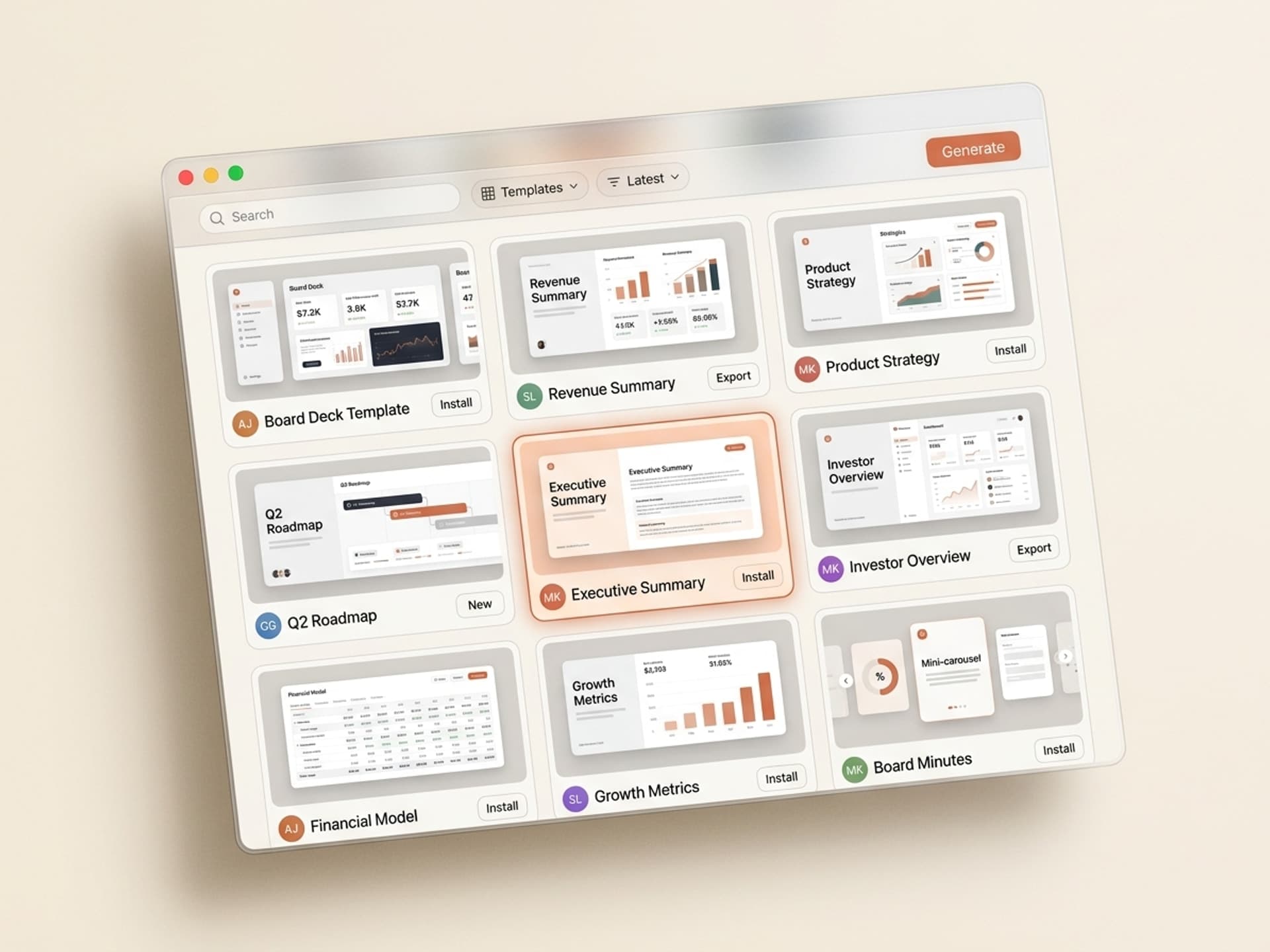
Claude, Cursor, ਅਤੇ ਹੋਰਾਂ ਲਈ ਸੈਂਕੜੇ ਤਿਆਰ-ਕੀਤੇ ਹੁਨਰ ਬ੍ਰਾਊਜ਼ ਕਰੋ।
Board Deck Anatomy: What a Modern Board Update Has to Cover
The 2026 board deck has six required sections. Skip any of them and the board either disengages or starts second-guessing the founder. Pile on more and the meeting overflows the 90-minute window.
| Section | Slides | What it answers | What goes wrong without it |
|---|---|---|---|
| 1. CEO opening + headline | 1 - 2 | What changed since last meeting? | Board reads the deck cold, no narrative |
| 2. KPIs + financial snapshot | 4 - 6 | Are we on plan? | Board questions every number live, eats the meeting |
| 3. Strategic milestones + roadmap | 3 - 5 | Did we ship what we said? | Board loses faith in the operating plan |
| 4. Hiring, culture, ESG | 2 - 3 | Is the team healthy? | Investors miss attrition or comp signals |
| 5. Risks + mitigations | 1 - 2 | What's keeping the CEO up at night? | Board feels surprised when bad news lands |
| 6. The asks | 1 - 2 | What do you need from the board? | The board leaves the room with no homework |
A standard Seed-to-Series-B board deck lands at 18 to 25 slides. Anything shorter, the board feels under-informed. Anything longer, they stop reading by slide 12. The opening slide should NOT be the logo or the agenda. It should be the CEO headline: one sentence about what changed. "We hit the plan, here's how" or "We missed the plan, here's the fix" - that single line frames the entire 90-minute meeting.
Board deck AI skills on Vibe Skills build this opening slide automatically, generate the KPI dashboard from your financial inputs, and reframe the deck around the CEO headline you provide.
How Much Time Founders Lose to Board Deck Prep
The 8-to-15-hour average breaks down predictably across a Series A or B founder:
- 4.2 hours pulling KPIs from Stripe, Carta, Pulley, and the ARR/MRR dashboards
- 3.1 hours designing slides and fixing brand template alignment
- 2.4 hours writing narrative copy for milestones and risks
- 1.8 hours in chart styling (boards hate inconsistent charts more than any other founder sin)
- 1.2 hours in pre-meeting alignment with the COO, CFO, and lead investor
- 1.0 hour in the late-night final rewrite
60% of that time is on data formatting and design, not on insight. Insight is what the board pays for. Formatting is exactly what an AI skill is built to absorb. Founders using a board deck skill on Vibe Skills typically land at 45 to 65 minutes total prep, which redirects roughly 12 hours per quarter back into product, fundraising, and customer work.
The 5 Best Board Deck AI Skills on Vibe Skills
These are the five board deck skills we recommend in 2026. All of them live in the Presentations category on Vibe Skills and ship on subscription pricing.
1. Board Update Deck Generator (Series Seed to Series A)
Best for first-time founders running their first 4 to 8 board meetings. Ships a 16 to 22 slide deck with the standard six-section structure, an automatic KPI dashboard, and clean Stripe / Carta input fields so you can paste the latest numbers without re-formatting them. The default narrative tone is calm and operator-led: no hype, no excuses, no buried bad news.
Best paired with: a 30-minute pre-board call with your lead investor.
2. Series B Board Deck Pro
For Series B and later boards where the deck doubles as a strategic planning artifact. Adds a strategic deep-dive module (pricing changes, market expansion, M&A, competitor moves) and a board-only appendix with cohort analysis, retention curves, and burn-and-runway models. Output: 22 to 28 core slides plus a 10 to 15 slide appendix the board reads async.
Best paired with: a quarterly CFO review, since the financial slides need a finance owner.
3. Investor Board Update (Pulley + Carta Edition)
For founders managing their cap table on Pulley or Carta who want secondary changes to flow into the deck automatically. Adds a cap table change slide, a dilution scenario slide for the next round, and an option pool refresh slide that boards always want to discuss but founders rarely volunteer. Saves 90 minutes per meeting on cap table prep alone.
Best paired with: any board where you anticipate a future fundraising or option pool conversation.
4. Operator Board Deck (COO Format)
Designed for COO or Chief of Staff prep, not CEO prep. Defaults to a more operational frame: shipping velocity, hiring health, support load, infrastructure cost, security posture. Useful when the board has an operator partner (Sequoia, Index, Founders Fund all have operator partners now) who reads the deck through an ops lens.
Best paired with: a CEO deck the same quarter, since the two play different roles.
5. Quarterly Board Recap (90-Minute Meeting Format)
Optimized for boards that want a tight 90-minute meeting with no overrun. Strips the deck to 14 to 18 slides, front-loads the asks to slide 3, and time-codes each section in the speaker notes so the CEO can pace the meeting from the deck itself. Best when your board is multi-fund and time is the binding constraint.
Best paired with: a no-overrun board chair who runs a hard stop at 90 minutes.
All five skills are included on a Vibe Skills subscription. Pro plan starts at $39/month with unlimited downloads.
The 1-Hour Board Deck Workflow
Most founders ship board decks in the wrong order: start with slide 1, get stuck on the headline by slide 2, panic-build slides 12 to 25 the night before. The AI-skill workflow inverts this. Build the data first, the narrative second, the design last.
Step 1: Pick the right skill on Vibe Skills (5 min)
Browse the Presentations category and pick the skill that matches your stage. Series Seed to Series A: Board Update Deck Generator. Series B and later: Series B Board Deck Pro. Cap-table-heavy: Investor Board Update.
Step 2: Paste the core inputs (15 min)
Every board deck skill asks for the same baseline inputs:
- CEO headline (1 sentence: "we hit the plan" or "we missed the plan and here is the fix")
- KPIs vs plan: ARR or MRR, gross margin, burn, runway, net revenue retention
- Top 3 strategic milestones shipped
- Top 3 strategic milestones missed
- Hiring numbers (hires, departures, open roles)
- Risks (top 3 with current mitigations)
- Asks (1 to 3 specific things you want from the board)
The 15 minutes is real. Most founders already have this in scattered docs, dashboards, and Slack threads. The skill walks you through each input one at a time.
Step 3: Let the skill generate v1 (5 to 8 min)
The skill runs the inputs through Claude or GPT (the skill author picks the right model) and produces the full deck: CEO opening using your headline verbatim, KPI dashboard with consistent chart styling, 3 to 5 strategic milestone slides with shipped vs missed visualized, a hiring heatmap, a risk register, and a clean asks slide as the closing artifact. Editor-ready in 5 to 8 minutes, not a rough draft.
Step 4: Edit the 20% that matters (25 min)
Most founders change the financials slide to match the latest CFO numbers, swap one or two visualizations, and rewrite the risk register in their own voice. Everything else ships as-is. The skill output already passes board scrutiny on layout and typography.
Step 5: Pre-share with the lead investor (5 min)
Send the deck to the lead investor 48 hours before the meeting. Boards that pre-read the deck spend the meeting on judgment, not on questions about chart axes. The lead investor will flag the one or two slides that need adjustment before the full board sees it.
Step 6: Lock the file and send to the board (5 min)
Export to your board's preferred format (PDF for archive plus Google Slides for live editing), then upload to the board portal with read receipts on.
Total time: 60 minutes. Versus the 8-to-15-hour baseline, that's a 12-to-14-hour quarterly recovery.
Frequently Asked Questions
Should I send the board deck before the meeting or present it live?
Send it 48 hours before the meeting. Boards that pre-read the deck spend the live meeting on judgment, not on questions about charts. The standard rhythm is: deck out 48 hours ahead, async questions in a shared doc 24 hours ahead, live meeting focused on the asks and the strategic deep-dive only. AI board deck skills on Vibe Skills format the deck so it reads cleanly even when the board reads it cold.
How do I keep confidential financials safe when using an AI skill?
Use a skill that runs in your own workspace, not a public tool. Board deck skills on Vibe Skills run in the AI tool you already use (Claude, GPT, Gemini) under your own enterprise account, so the financial inputs you paste in stay inside your existing data boundary. Never paste live financials into a public web tool with no enterprise contract.
How long should a board deck actually be?
A standard Series Seed to Series B board deck runs 18 to 25 slides for the core deck, with an additional 10 to 15 slide appendix for the financial deep-dive. Anything under 14 slides leaves the board under-informed. Anything over 30 slides loses the room. The Vibe Skills board deck skills default to this range and let you toggle the appendix on or off depending on the board's appetite.
How is a board deck different from an investor pitch deck?
A pitch deck is a hook for a meeting that has not happened yet. A board deck is a status update for an ongoing relationship. Pitch decks sell vision. Board decks deliver evidence. The structure, length, and tone are completely different. The pitch deck skills on Vibe Skills (covered in our pitch deck guide) are NOT the same as the board deck skills - use the right one for the audience.
Can the board tell I used an AI skill to build the deck?
No, if the skill is well-built. The board deck skills on Vibe Skills ship investor-grade layouts that are visually indistinguishable from a designer-built deck. The board cares about whether the data is right and whether the strategy is sound, not whether the chart was rendered by Figma or by an AI skill. What gets caught is sloppy data, not the rendering tool. The 25 minutes you spend editing the 20% that matters is what makes the deck land.
How often should the board deck format change?
Keep the format consistent for at least 4 quarters in a row. Boards read decks faster when the format is stable - they know where to find the burn slide, the runway slide, the asks slide. AI board deck skills enforce consistency by default, which means quarter-over-quarter the board can compare KPIs at a glance instead of relearning the layout every time.
What if I miss the plan? How do I cover bad news in the deck?
Lead with it. Slide 1 is the CEO headline. If you missed the plan, the headline is "We missed [metric] by [%], here is the fix." Boards punish founders for burying bad news, not for delivering it. The board deck skills on Vibe Skills include a plan-miss narrative module that generates a clean three-slide sequence: what happened, why, and the corrective action. Boards respond to that structure far better than to a defensive deflection.
Stop Spending a Work Week per Year on Board Deck Prep
A board deck is the founder's quarterly judgment artifact. It deserves the founder's brain on the strategic message and almost none of the founder's brain on the layout, the chart styling, or the typography.
AI board deck skills on Vibe Skills take the formatting and narrative scaffolding off the founder's plate and ship investor-grade decks in 5 to 8 minutes of generation time. The founder spends the recovered 12 hours per quarter on what the board actually pays for: judgment, focus, and operating discipline.
Browse board deck skills on Vibe Skills →
Stop pulling all-nighters before every board meeting. Install a board deck skill on Vibe Skills and recover a work week per year.