

Dlulisa amehlo ezinkulumbeni zamakhono alungile we-Claude, Cursor, nokunye okwengeziwe.
The Best AI Skills for 3D Hero Sections: Why 2026 Is the Year It Goes Mainstream
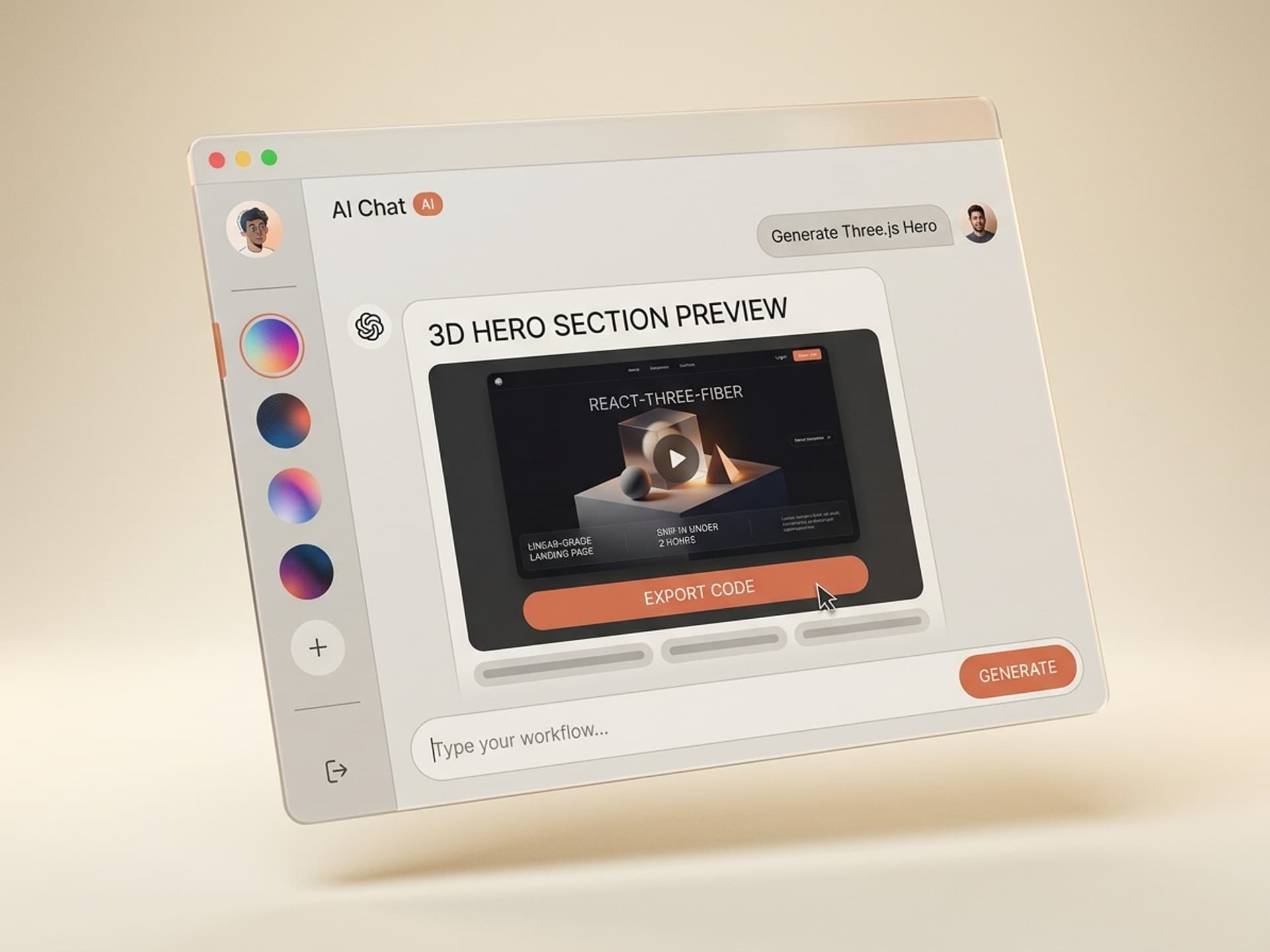
The best AI skills for 3D hero sections in 2026 generate a Three.js scene that renders your brand assets in real time, ships in under 2 hours, and replaces a $5,000 - $20,000 freelance contract. A 3D landing page hero used to be a quarterly engineering project. It is now a Friday afternoon.
Linear, Stripe, Vercel, Arc, Rive, Liveblocks, and Cursor all moved their landing pages to interactive 3D between 2023 and 2026. Conversion teams at Stripe and Vercel reported double-digit lifts in scroll depth and signup rate after the redesign. The pattern is now the default for premium SaaS, and a flat hero now reads as off-trend.
This guide covers the five interactive 3D hero skills we recommend on Vibe Skills in 2026, what each one ships, and how to put a real 3D hero on your site this week.

Dlulisa amehlo ezinkulumbeni zamakhono alungile we-Claude, Cursor, nokunye okwengeziwe.
Why 3D Heroes Now Signal "Premium" by Default
A 3D hero is the new "we are a serious company" signal. Five years ago that signal was a custom illustration. Three years ago it was a Lottie animation. In 2026 it is an interactive 3D scene the visitor can rotate, scrub, or trigger with a scroll.
The shift happened because the cost of WebGL collapsed. react-three-fiber made Three.js feel like writing React. drei packaged the 90% case (orbit controls, environment maps, GLTF loaders, instanced meshes) into one-line components. Spline let designers build scenes without code. The bar moved from "should we have 3D" to "why don't we have 3D".
Some reference points from the current frontier:
- Linear uses a 3D issue graph that responds to cursor movement on its homepage hero
- Stripe ships a parametric 3D ribbon that animates per-section as you scroll
- Vercel runs an instanced particle field that reacts to navigation
- Arc built an entire 3D browser preview as the hero
- Rive shows real product files spinning in WebGL above the fold
Visitors do not always notice the 3D consciously. They notice that the page feels expensive. That feeling is what closes the sign-up.
The conversion data backs this up. Multiple SaaS teams that swapped a flat illustration for a low-poly 3D hero reported 5 - 14% lifts in time-on-page and 2 - 6% lifts in trial signup. The lift is not magic. It is the same mechanism as a beautiful pitch deck: the page reads as built by people who care, so the product reads the same way.
The catch used to be cost. A custom Three.js hero from a freelance specialist runs $5,000 - $20,000 and takes 3 - 6 weeks. AI skills collapse that to 2 hours and one subscription.

Dlulisa amehlo ezinkulumbeni zamakhono alungile we-Claude, Cursor, nokunye okwengeziwe.
The Anatomy of a Great 3D Landing Page Hero
A 3D hero is not just "a model in a box". A hero that converts has five layers, and an AI skill needs to ship all five for the output to actually feel like Linear-grade work.
| Layer | What it does | Why it matters | Common mistake |
|---|---|---|---|
| Model | The 3D object on screen (logo, product, abstract shape) | The hook. First thing the visitor sees. | Using a stock model that looks generic |
| Lighting | Environment maps + key/fill lights | Sells the surface as real material | Flat ambient light that kills depth |
| Animation | Rotation, scroll-tied movement, hover reaction | Makes the scene feel alive instead of static | Auto-spin loops that look like a screensaver |
| Interactivity | Cursor parallax, click triggers, scroll scrub | Pulls the visitor into the scene | No interactivity, so it reads as a video |
| Mobile fallback | Static image or low-poly version on touch devices | 60% of traffic is mobile - WebGL drains battery | Shipping the full scene on mobile and tanking LCP |
A real 3D hero skill ships all five layers. A bad one ships a model and calls it done.
The mobile fallback is the biggest blind spot. Three.js on a mid-range Android phone can drop a Largest Contentful Paint score from 1.2s to 4.8s, which Google flags as "poor". The fix is one of three patterns:
- Static poster: render the scene to a high-quality JPG/WEBP, ship that as the mobile hero, swap in the live scene only on
pointer:fine - Low-poly variant: ship a 200-tri version of the model with no environment map on mobile
- Lazy-mount: only mount the Canvas after the user scrolls past the hero, so initial paint is the static poster
Every Vibe Skills 3D hero skill includes the mobile fallback as the default, not an afterthought.
5 AI Skills for 3D Hero Sections on Vibe Skills
These are the five interactive 3D hero skills we recommend in 2026. All live in the Interactive 3D category on Vibe Skills and ship as react-three-fiber components ready to drop into a Next.js, Remix, or Astro project.
1. Linear-Style Floating Object Hero
The "single hero object floating above the fold" pattern. Pass in a logo or product mark, the skill rigs it as a GLTF, applies a brushed-metal or glass material, sets up rim lighting, and adds cursor parallax that tilts the object 6 degrees off the mouse position.
Best for: SaaS homepages, dev tools, fintech, anything that wants to feel like Linear or Arc.
Output: <Hero3D /> React component, GLTF model, 1 mobile poster JPG.
Time to ship: 90 minutes from input to deployed.
2. Stripe-Style Parametric Ribbon
The animated ribbon / wave / flow pattern that sells motion before product. The skill generates a parametric mesh (sine/curl noise driven), applies a gradient material in your brand colors, and ties the animation phase to scroll position so the ribbon morphs as the visitor moves down the page.
Best for: Payments, infrastructure, API products, any pitch where "movement" is part of the metaphor.
Output: <RibbonHero /> component with scroll-tied uniforms, mobile fallback is a still gradient frame.
3. Particle Field Hero
Instanced particle / dot field that reacts to cursor or scroll. The skill places 5,000 - 50,000 instanced meshes (capped per device tier), drives them with a noise field, and adds a cursor-attractor so the particles part around the pointer.
Best for: AI products, data tools, infrastructure brands, anything where "scale" or "intelligence" is the message.
Output: <ParticleHero /> with auto-quality scaling (drops particle count on weaker GPUs to hold 60fps).
4. Product 3D Spin Hero
The "rotate your actual product in 3D above the fold" pattern. The skill takes a GLTF you supply (or generates a low-poly version from a single product render via image-to-3D), applies studio lighting, and lets the visitor drag to rotate or auto-orbits in idle.
Best for: Hardware brands, physical products, e-commerce, fashion, design tool previews.
Output: <ProductHero /> with <OrbitControls /> configured for 60 degree clamp, full mobile gesture support.
5. Scroll-Driven Scene Hero
The most ambitious of the five. A multi-stage 3D scene where each scroll position swaps the camera angle, lighting, and active object. Used by Apple product pages, Vercel's Edge Functions page, and Liveblocks' Yjs page.
Best for: Product launches, feature deep dives, anything that tells a 3-stage story above the fold.
Output: <ScrollScene /> component built on react-three-fiber + @react-three/drei + Lenis smooth scroll, with named camera waypoints you can edit in JSON.
Browse all interactive 3D skills on Vibe Skills
How to Ship a 3D Hero in Under 2 Hours
The full workflow from "we want a 3D hero" to "it is live on production". Step 1 is always picking the right skill on Vibe Skills - do not start by writing Three.js boilerplate.
Step 1: Pick the right skill on Vibe Skills
Go to the Interactive 3D category on Vibe Skills and match the pattern to your product. SaaS dashboard product picks Linear-Style Floating Object. API/infra product picks Stripe-Style Ribbon. Hardware product picks Product Spin. AI product picks Particle Field. Storytelling launch picks Scroll-Driven Scene.
If you are not sure, the Linear-Style Floating Object skill is the lowest-risk default. It works for 70% of SaaS landing pages.
Step 2: Provide the inputs
Every 3D hero skill on Vibe Skills asks for the same six inputs:
- Brand colors (primary + 1 accent, hex codes)
- Logo or hero mark (SVG preferred, PNG accepted)
- Product asset (GLTF, OBJ, or product render JPG if no 3D file exists)
- Mood reference (1 - 3 URLs of sites whose 3D feel you like)
- Tech stack (Next.js, Remix, Astro, plain Vite, etc.)
- Mobile strategy (static poster, low-poly, or lazy-mount)
If you do not have a GLTF, the skill auto-generates a low-poly version from a single product render. If you do not have a product, it uses your logo.
Step 3: Generate and preview
The skill runs and produces:
- A
react-three-fibercomponent (<Hero3D />or similar) - The GLTF model file
- A mobile poster JPG/WEBP
- A
next.config.jspatch for proper GLTF loader handling - A README with the install command
Preview on Vibe Skills' live sandbox. Change one color, swap one prop, see the result.
Step 4: Drop it into your project
pnpm add three @react-three/fiber @react-three/drei
Copy the component into your components/ folder, copy the GLTF into public/3d/, and import the component into your hero section. The skill ships TypeScript types and is tree-shakeable.
Step 5: Verify performance
Run Lighthouse on desktop AND mobile. The skill's mobile fallback should keep LCP under 2.5s. If you see a regression, switch the mobile strategy from "lazy-mount" to "static poster".
Step 6: Ship
Total elapsed time from Step 1 to deployed: 90 - 120 minutes for a first-time user. 30 - 45 minutes if you have shipped one before.
Frequently Asked Questions
Is a 3D hero bad for performance?
Not if it is built right. The skills on Vibe Skills ship with a mobile poster fallback and lazy-mount the Canvas, so the hero does not block first paint. Real-world Lighthouse scores after a properly built 3D hero install land at 90+ on desktop and 80+ on mobile, with LCP under 2.5s.
How big is the JS bundle for Three.js?
Three.js + react-three-fiber + drei adds roughly 120 - 180 KB gzipped to your bundle. This is comparable to a large Lottie animation and smaller than most analytics SDKs. Code-split it behind the hero component so it only loads when the visitor reaches the page that actually uses 3D.
Do I need a 3D model file or does the AI skill make one?
Either works. If you have a GLTF, OBJ, or FBX file, the skill uses it directly. If you only have a product render or your logo, the skill generates a low-poly GLTF for you using image-to-3D (typically 200 - 2,000 triangles, optimized for web). Browse Interactive 3D skills to see which skills include image-to-3D.
What about mobile? Won't 3D drain the battery?
The skills on Vibe Skills handle this. Default behavior on touch devices is a high-quality static poster, with the live 3D scene only mounting on hover (which never fires on touch) or after the user scrolls past the fold. You can also opt into a low-poly variant that runs on mobile at 30fps with negligible battery cost.
Can I use Spline scenes instead of writing Three.js?
Yes. Two of the Interactive 3D skills on Vibe Skills export to Spline format if you prefer the no-code editor. The trade-off is bundle size - Spline's runtime is 300 - 500 KB gzipped vs Three.js + r3f at 120 - 180 KB. For a marketing site that ships fast, raw Three.js wins. For a designer-led iteration loop, Spline wins.
Will the AI-generated 3D hero look generic?
No - the skills on Vibe Skills are built by motion designers who have shipped 3D heroes for production SaaS sites. The AI fills in your brand assets, colors, and content while the visual system, lighting setup, and animation curves stay hand-crafted. Browse the Interactive 3D category to preview real output before you buy.
How does this compare to hiring a Three.js freelancer?
A freelance Three.js specialist runs $80 - $200/hour and a hero typically takes 30 - 80 hours including revisions. That is $2,400 - $16,000 for one hero, with a 3 - 6 week turnaround. A Vibe Skills subscription starts at $39/month and ships a hero in 90 minutes. The skill pays back on the first hero and keeps paying back across every product page, every campaign landing, and every microsite you ship.
Can I edit the generated component after install?
Yes. The output is plain TypeScript + react-three-fiber. You own the file. Edit colors, swap materials, retune the animation curves, change the camera FOV. The skill ships clean, commented code, not a black box.
The Quick CTA: Stop Building 3D Heroes From Scratch
A 3D hero is now the default for premium SaaS in 2026, the same way a Lottie animation was the default in 2022. The teams shipping 3D heroes are not all hiring Three.js specialists - they are installing AI skills that ship the whole stack (model, lighting, animation, interactivity, mobile fallback) in under 2 hours.
If you have been putting off the 3D hero because the freelance quote was $8k or because the engineering ticket has been in the backlog since Q3, you can ship it this afternoon.
Browse 3D hero skills on Vibe Skills →
Skip the $8,000 freelance quote and the 6-week timeline. Install a 3D hero skill on Vibe Skills.