

Pilih ratusan kaahlian nu geus siap pikeun Claude, Cursor, jeung sajabana.
How to Build a B2B SaaS Sales Deck That Actually Closes in 2026
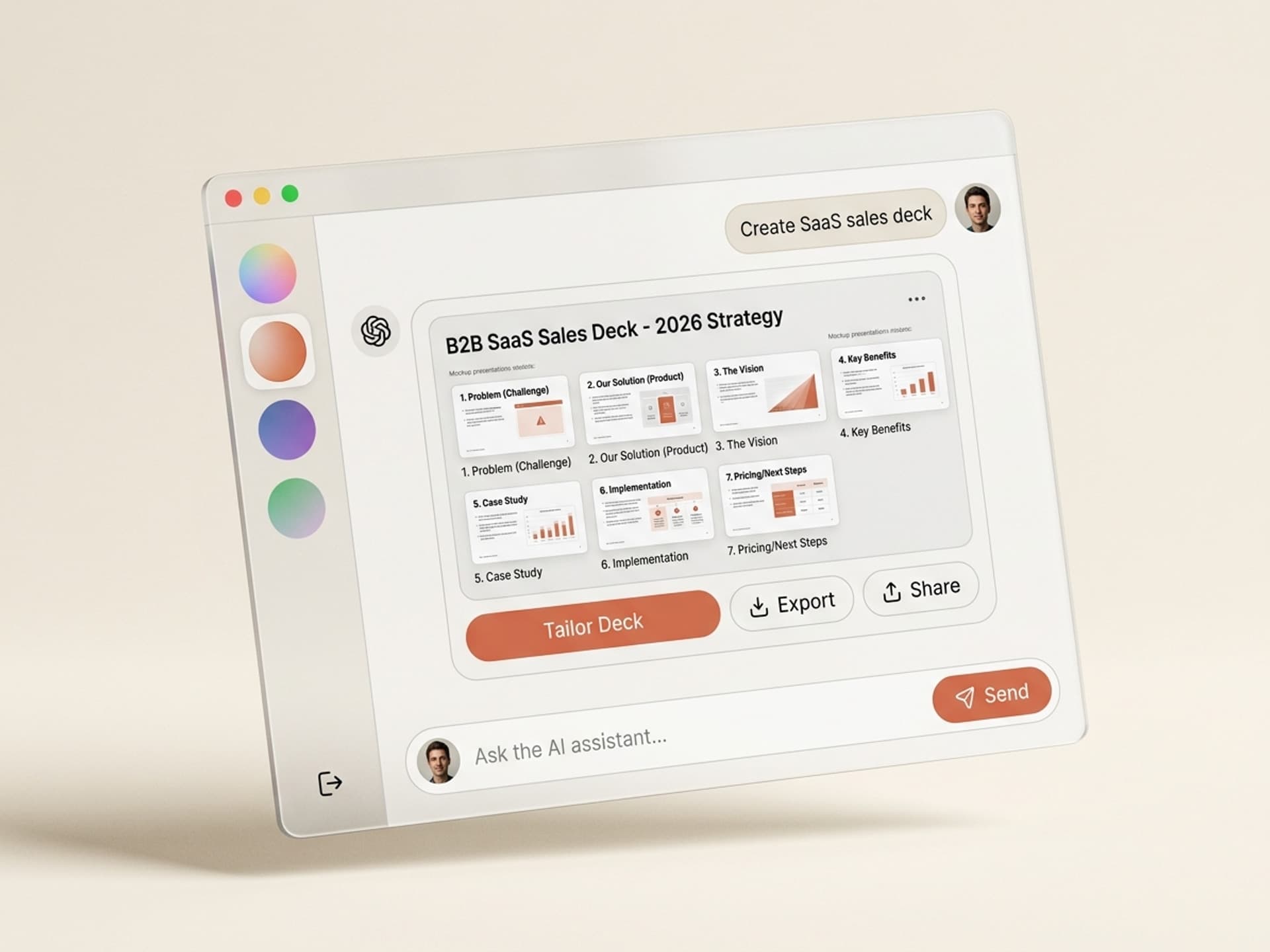
A B2B SaaS sales deck is a 7-to-12 slide narrative that turns a discovery call into a signed contract. It is not a pitch deck. Pitch decks raise capital. Sales decks close customers. The structure is different, the audience is different, and the close is different. With Vibe Skills, AEs ship a fully-tailored sales deck per prospect in roughly 20 minutes.
Most SaaS founders bolt the cap table slide onto an investor deck and wonder why win rates stall at 18%. This guide fixes that with a sales-specific 7-slide anatomy, and shows the exact AI skills that build it.
Pilih ratusan kaahlian nu geus siap pikeun Claude, Cursor, jeung sajabana.
Why Sales Decks Are Different from Pitch Decks
Sales decks and pitch decks share zero structural DNA. Both have slides. That is where the similarity ends.
A pitch deck sells the company to an investor. The hero is the founder, the proof is traction, the close is "wire $2M." A sales deck sells the product to a buyer. The hero is the prospect, the proof is ROI, the close is "sign the order form."
Here is the side-by-side that most teams get wrong:
| Element | Pitch Deck | B2B SaaS Sales Deck |
|---|---|---|
| Audience | VC partner | Director / VP / CRO at the buyer |
| Hero of story | The founder | The prospect's team |
| Slide 1 hook | Market size, vision | Prospect's stated pain |
| Proof type | Traction, MRR growth, logos | ROI math, case study with similar buyer |
| "Why now" slide | Market timing | Prospect's quarter / OKR / mandate |
| Demo | Roadmap screenshot | Live product flow |
| Close slide | "We're raising $5M at $25M post" | "Pilot timeline + commercial terms" |
| Total slides | 10 - 14 | 7 - 12 |
| Time on call | 20 min monologue | 35 min dialogue |
The biggest gap: sales decks are not monologues. According to Gong's 2025 State of Sales Calls research, top-performing AEs talk for 43% of the discovery-to-demo call and let the buyer talk for the other 57%. A pitch deck is meant to be presented. A sales deck is meant to be navigated based on what the buyer says in the room.
That changes everything about how the deck is built. Slides need to stand on their own when emailed as a leave-behind. They need to flex by industry, by persona, and by deal size. And every prospect deserves a tailored version - not the same 10 slides re-skinned with the buyer's logo.
Pilih ratusan kaahlian nu geus siap pikeun Claude, Cursor, jeung sajabana.
Why Generic Templates Lose Deals
Generic decks lose deals because buyers can smell a templated pitch in 90 seconds. Forrester's 2025 B2B Buyer Survey found that 74% of buyers say the vendor that was most helpful in framing their problem won the deal - even when they were not the cheapest option.
A templated deck signals three things, none of them good:
- "We did not bother to research your business"
- "Our product is not differentiated enough to map to your use case"
- "Our sales motion is order-taking, not consultative"
Three patterns kill more deals than pricing objections combined:
- The feature dump. 14 slides of "we do X, we do Y, we integrate with Z." Zero buyer-specific framing. Win rate on these decks averages 11% in B2B SaaS pipeline data shared by Klue.
- The case study mismatch. Pitching a 2,000-person enterprise with a Series A logo wall. The buyer thinks "you have never sold into my segment."
- The closing slide vacuum. No CTA, no next step, no commercial framework. The buyer leaves the call without a path to "yes."
The fix is not to write better slides. The fix is a structured anatomy that flexes to each prospect, paired with a way to actually produce that flex per deal without burning 6 hours of AE time.
That is exactly what skills in the Presentations category on Vibe Skills are built for.
The 7-Slide Sales Deck Anatomy That Closes
A B2B SaaS sales deck that closes in 2026 has 7 mandatory slides and 3 - 5 optional ones depending on deal complexity. Here is the anatomy, in narrative order:
| # | Slide | Purpose | What goes on it |
|---|---|---|---|
| 1 | Their world today | Mirror the prospect's current pain back to them | A diagram of their current workflow with the bottleneck circled |
| 2 | The cost of the status quo | Quantify what doing nothing costs | Specific dollar / hour / FTE cost over 12 months |
| 3 | The shift happening in their market | Establish urgency without being pushy | Industry stat + "X% of leaders are moving to Y" |
| 4 | Your product as the bridge | One slide, one sentence, one diagram | Crisp product positioning, not a feature grid |
| 5 | Live demo (or 3-screen flow) | Show the product solving their exact use case | Real screens, real data shape, mapped to their team |
| 6 | Proof: case study from a lookalike buyer | De-risk the decision | One named customer, same segment, with measurable outcome |
| 7 | Pilot framework + commercial terms | Make "yes" easy to say | Timeline, success criteria, pricing, who signs what |
Optional slides to add when the deal warrants:
- Security & compliance (always include for buyers > 500 FTE)
- Implementation timeline (for deals with switching cost)
- Integration map (for technical buyers)
- Reference customers (for committee deals with 4+ stakeholders)
- Mutual action plan (for deals over $50K ARR)
Notice what is missing: no "About Us" slide, no team slide, no roadmap slide, no investor logo wall. A B2B buyer does not care that you raised a Series B. They care that the procurement timeline maps to their fiscal year.
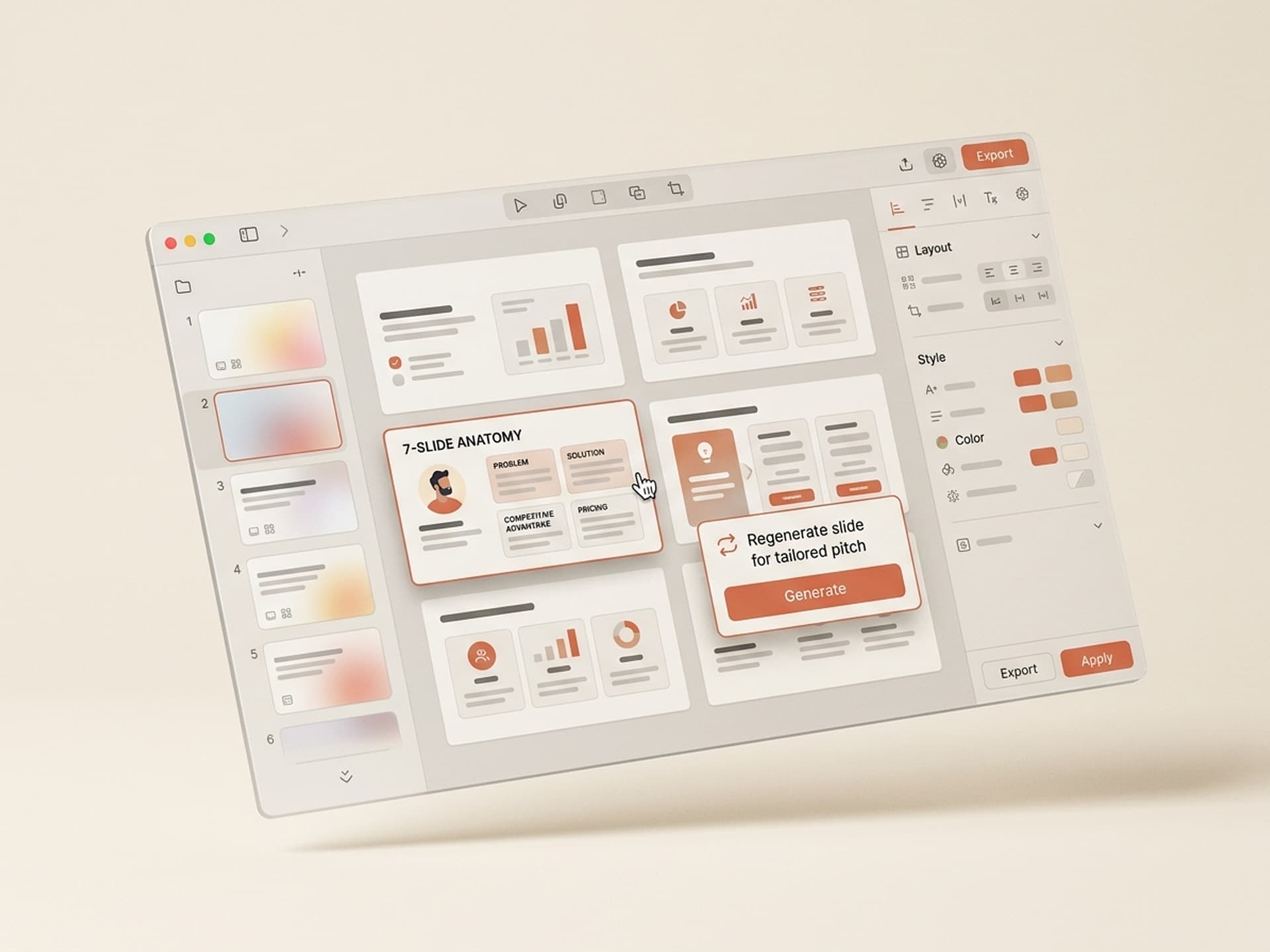
The hardest slides to build well are #1, #2, and #6 - because they are buyer-specific by definition. That is where AI skills cut the most time.
AI Skills for Sales Decks on Vibe Skills
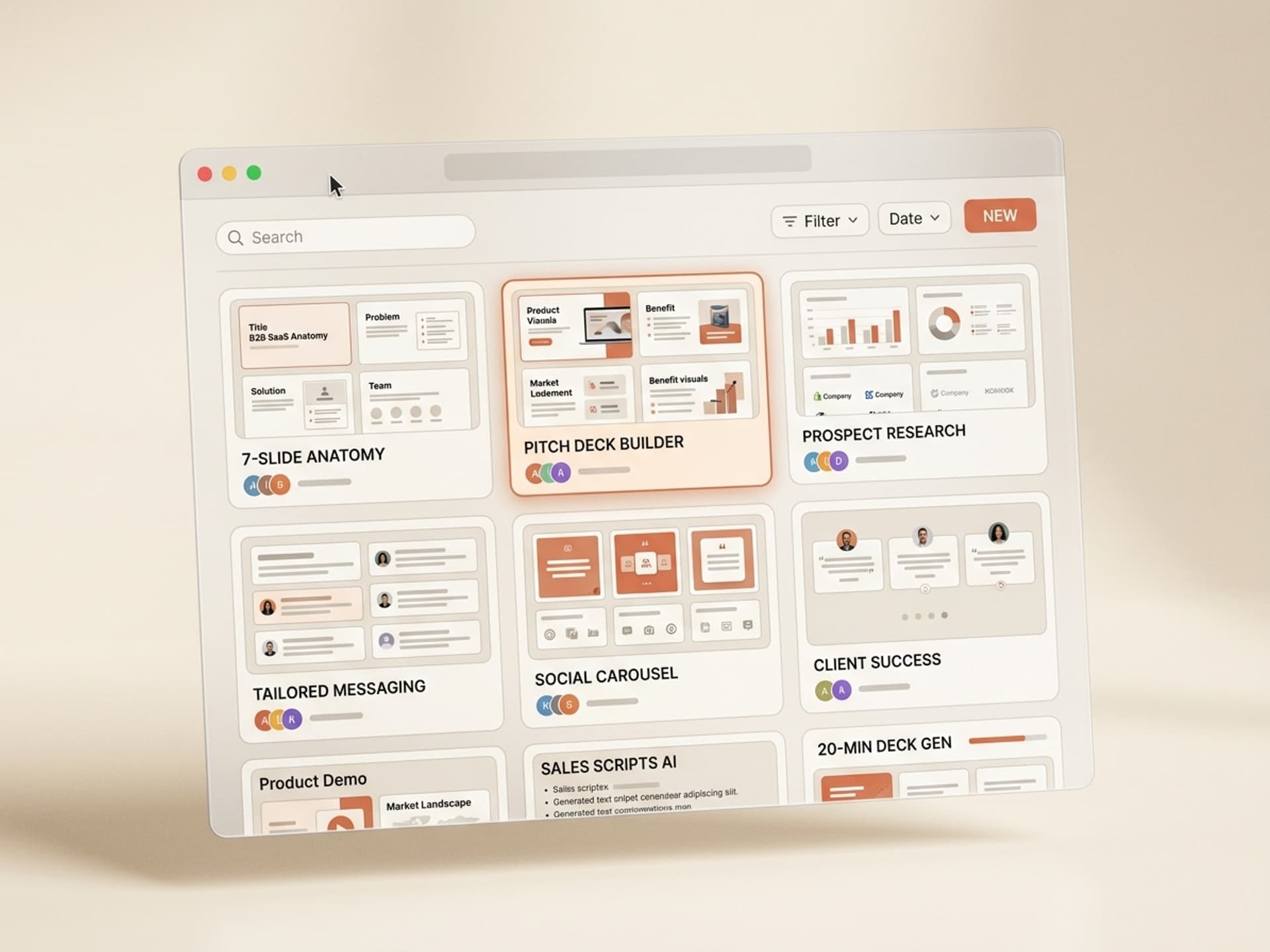
Sales deck skills on Vibe Skills ship as packaged workflows. You feed in the prospect's industry, persona, deal size, and stated pain, and the skill outputs the slides in your brand system - either to PowerPoint, Google Slides, or Figma. They are built specifically for the sales motion, not repurposed pitch deck templates.
Here is what is in the Presentations category for sales-focused decks:
| Skill | Best for | Output | Browse |
|---|---|---|---|
| B2B Sales Demo Deck | First-call discovery to demo | 9 slides, Google Slides + PowerPoint | Vibe Skills |
| Enterprise Sales Deck | Committee deals, $50K+ ARR | 12 slides + security appendix | Vibe Skills |
| QBR Sales Deck | Expansion / renewal calls | 8 slides, lifecycle-tuned | Vibe Skills |
| ROI Calculator Slide Pack | Inserts a buyer-specific ROI page into any deck | 1 - 3 slides, editable math | Vibe Skills |
| Lookalike Case Study Generator | Builds slide #6 from your CRM customer list | 1 slide per case, regenerates per prospect | Vibe Skills |
Each skill ships with the slide structure, the visual system, and the AI workflow that fills in the buyer-specific fields. You are not starting from a blank deck or copy-pasting from your last sales pitch.
Browse the Presentations category on Vibe Skills →
How to Build Your B2B SaaS Sales Deck in 20 Minutes
The 20-minute number is real, but only if you have the right skill installed and the right inputs ready. Here is the exact sequence top-performing AEs run for every priority deal.
Step 1: Pick the right skill on Vibe Skills. Open the Presentations category and pick the skill that matches the deal stage. Use the B2B Sales Demo Deck for first calls, the Enterprise Sales Deck for committee deals over $50K ARR, and the QBR Sales Deck for renewals or expansion. Install once and the skill is reusable for every prospect after that.
Step 2: Gather your 5 inputs. Before you open the skill, collect: (1) prospect's industry and headcount, (2) the buyer's title and stated pain from your discovery call notes, (3) one lookalike customer from your CRM with measurable outcomes, (4) the deal size and proposed pricing, (5) your brand system (logo, fonts, primary color). 90 seconds.
Step 3: Run the skill. Feed the inputs in. The skill builds slides #1, #2, #3, and #6 specifically for this buyer. Slides #4 (your product as the bridge) and #5 (demo flow) come pre-built from your library and only need a quick check that the screens match the buyer's use case.
Step 4: Tailor the cost-of-status-quo math. Slide #2 is the highest-leverage slide in the deck. Adjust the math to the buyer's actual numbers - if they have 40 reps and each rep loses 4 hours a week, do not let the skill output "the average company loses 5,000 hours a year." Make it specific. This is the single edit that wins more demos than any other.
Step 5: Drop in the pilot framework. Slide #7 is the close. Specify the pilot timeline (typically 14 - 30 days), the success criteria (one or two measurable outcomes), and who signs what. If the buyer asked for an SOW on the call, attach it as an appendix slide.
Step 6: Export and send within 4 hours of the call. The faster the recap deck lands in the buyer's inbox, the higher the win rate. Industry data from Outreach shows decks sent within 4 hours have a 35% higher follow-on meeting rate than decks sent the next day.
20 minutes from "ended the call" to "buyer has the deck." That is the workflow.
How Much Does a B2B SaaS Sales Deck Cost?
A custom-built sales deck from a freelance designer runs $1,500 - $5,000 and takes 5 - 10 business days. A Big-3 consulting deck runs $15,000+ and takes 3 - 4 weeks. With AI skills on Vibe Skills, a tailored sales deck per prospect costs effectively zero marginal dollars on a Pro plan ($39/month) or Premium plan ($79/month), and ships in under 30 minutes.
For sales teams of 5+ AEs, the Business plan ($300/month) covers up to 20 seats with shared brand systems and admin controls. At max fill that is $15 per seat per month for unlimited tailored decks.
The breakeven is brutal: one closed $25K ARR deal that would have stalled without a tailored deck pays back 26 years of a Pro subscription. Every additional deal closed is pure margin.
Frequently Asked Questions
What is the difference between a pitch deck and a sales deck?
A pitch deck sells your company to an investor and ends with "we are raising $X." A sales deck sells your product to a buyer and ends with "here is the pilot framework." Pitch decks are monologues, sales decks are dialogue tools. Different audience, different proof type, different close. Skills for both live in the Presentations category on Vibe Skills.
How many slides should a B2B SaaS sales deck have?
Seven mandatory slides for SMB and mid-market deals: today's pain, cost of status quo, market shift, your product, demo, lookalike case study, pilot framework. Add 3 - 5 optional slides (security, implementation, integrations, references, mutual action plan) for enterprise deals over $50K ARR. Anything past 12 slides loses the room.
Can I edit a sales deck after the AI skill generates it?
Yes. Every skill on Vibe Skills exports to PowerPoint, Google Slides, or Figma so you own the file and edit freely. Most AEs tweak the cost-of-status-quo math and the pilot framework slide for each deal, then ship the rest as-is. You stay in your existing workflow.
How is an AI sales deck different from using ChatGPT?
ChatGPT writes text. An AI skill ships a complete workflow - slide structure, visual system, brand system, and the AI logic that fills in buyer-specific fields. With ChatGPT you still need to design 9 slides from scratch in PowerPoint. With a Vibe Skills sales deck workflow, you get the finished file in your brand system in under 30 minutes.
Should I send the sales deck before or after the call?
After. Sending it before kills the conversation - the buyer pre-reads it and arrives with objections instead of questions. Use the discovery call to gather the inputs, build the tailored deck within 4 hours of the call, and send it as the recap. This is the pattern that drives the 35% lift in follow-on meeting rate.
Can one sales deck work for every prospect?
No, and trying to make one fit all is the single biggest mistake B2B SaaS teams make. Slides #1, #2, and #6 must be buyer-specific - their pain, their cost, a customer that looks like them. The rest can stay templated. AI skills make per-prospect tailoring fast enough that there is no excuse for sending the same deck twice.
What slides should I never include in a sales deck?
Skip the "About Us" slide, the founding-team slide, the investor logo wall, and the product roadmap. Buyers do not care who funded you, they care if you solve their problem this quarter. Replace those slides with: cost of status quo, lookalike case study, and pilot framework. That swap alone lifts close rates noticeably.
Stop Templating Sales Decks. Start Closing Deals.
The pattern is now well documented: buyer-tailored beats templated, every time. The blocker has always been time - building a custom 9-slide deck per prospect is 4 - 6 hours of AE work that nobody actually does. AI skills on Vibe Skills collapse that work into 20 minutes per deal, in your brand system, exported to your sales tools.
If you are running B2B SaaS pipeline in 2026 and your win rate is below 25%, the deck is the cheapest thing to fix. Pick a skill, run it on your next 5 priority deals, and watch what happens to your demo-to-close ratio.
Browse Presentation Skills on Vibe Skills →
Stop templating sales decks. Install a sales deck skill on Vibe Skills and ship a tailored deck per prospect in 20 minutes.